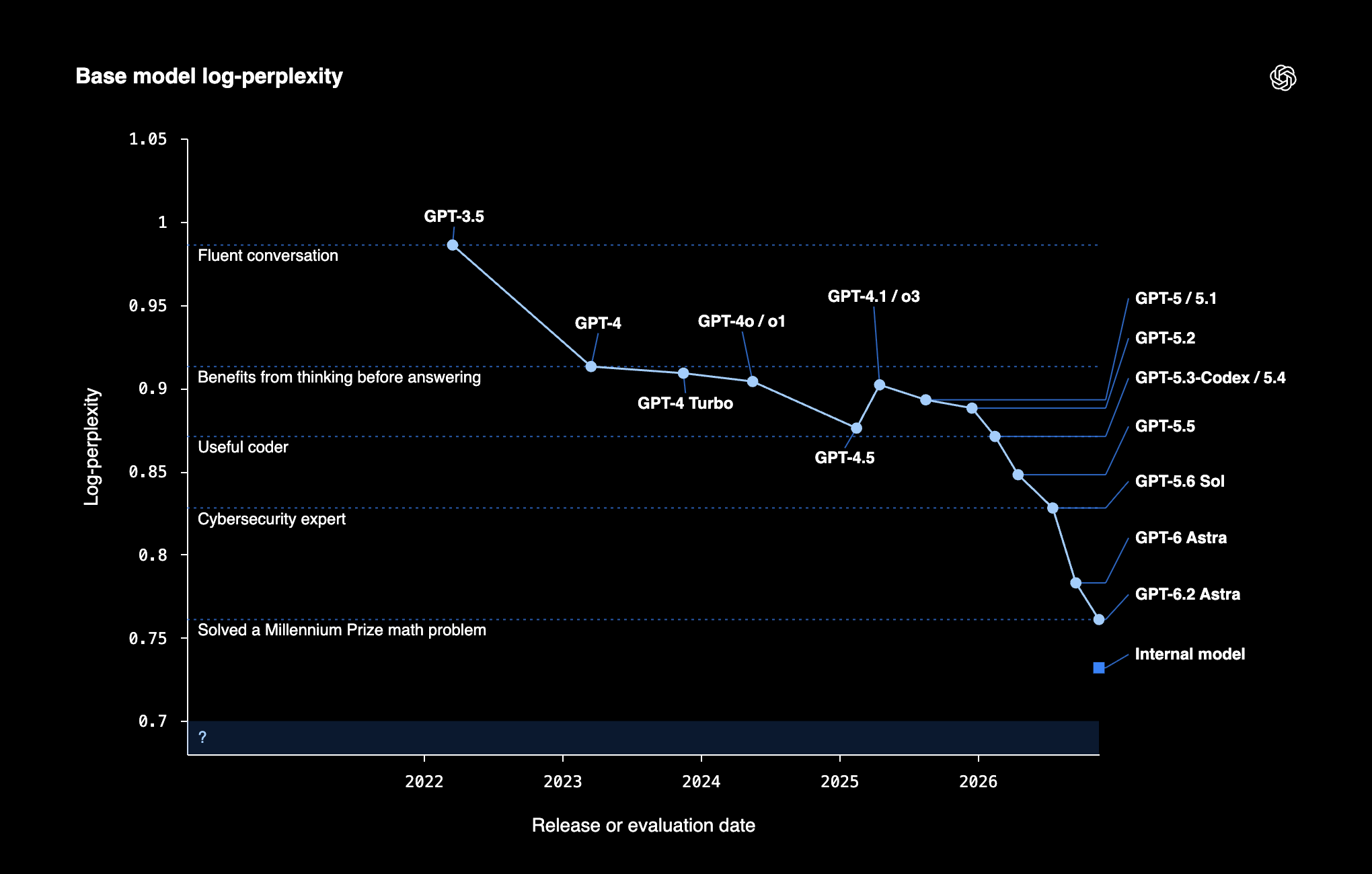
OpenAI have just released a fascinating graph showing the perplexity over time of all their released models:
Here are a bunch of thoughts I have about this:
Why OpenAI?
- This is the most visibility we’ve ever had into the internal training metrics at a frontier lab
- Releasing training metrics in the name of safety is a very Anthropic move, and it’s surprising OpenAI was the one to do it first
- Perplexity must be measured against some specific dataset (e.g. all models will score basically zero perplexity1 on the string “AAAAAAA….”)
- We therefore shouldn’t expect to be able to compare any similar data Anthropic releases with this data, except in terms of the angle on the graph2
Is perplexity a useful measure?
- Perplexity is an unsatisfying metric because it only predicts how well the model matches some held-out text: i.e. it only applies to pre-training
- For frontier models, the rumor is that pre-training is 50% or less of the total time and compute spent training a model; the rest is RL, which this perplexity data tells us nothing about the success of
- If you believe (as many do) that pre-training creates capabilities and RL merely elicits them, then perplexity would actually be a useful metric for capabilities (and indeed it does seem to go down over time as models get better)
- However, even if post-training does not add new capabilities, there are clearly other measures of capability that do not necessarily correlate with perplexity, like the ability to improve with chain-of-thought
What is surprising about the chart?
- Very few models share the same base (i.e. have the exact same perplexity). It was a common rumor that OpenAI was post-training 4o and 4.1 into many of their models, but it looks like it was just o1 and o3
- It’s interesting that 4.1 and o3 share the same base, given how great a model o3 was and how underwhelming 4.1 was
- You can see the point where OpenAI briefly give up on making large pretrained models at GPT-4.5, which had similar perplexity to GPT-5.3-Codex but was far less useful
It’s unclear whether OpenAI chose not to pretrain further or hit some kind of internal scaling wall, but it’s interesting to consider the world where they could keep smoothly scaling on top of GPT-4.5:
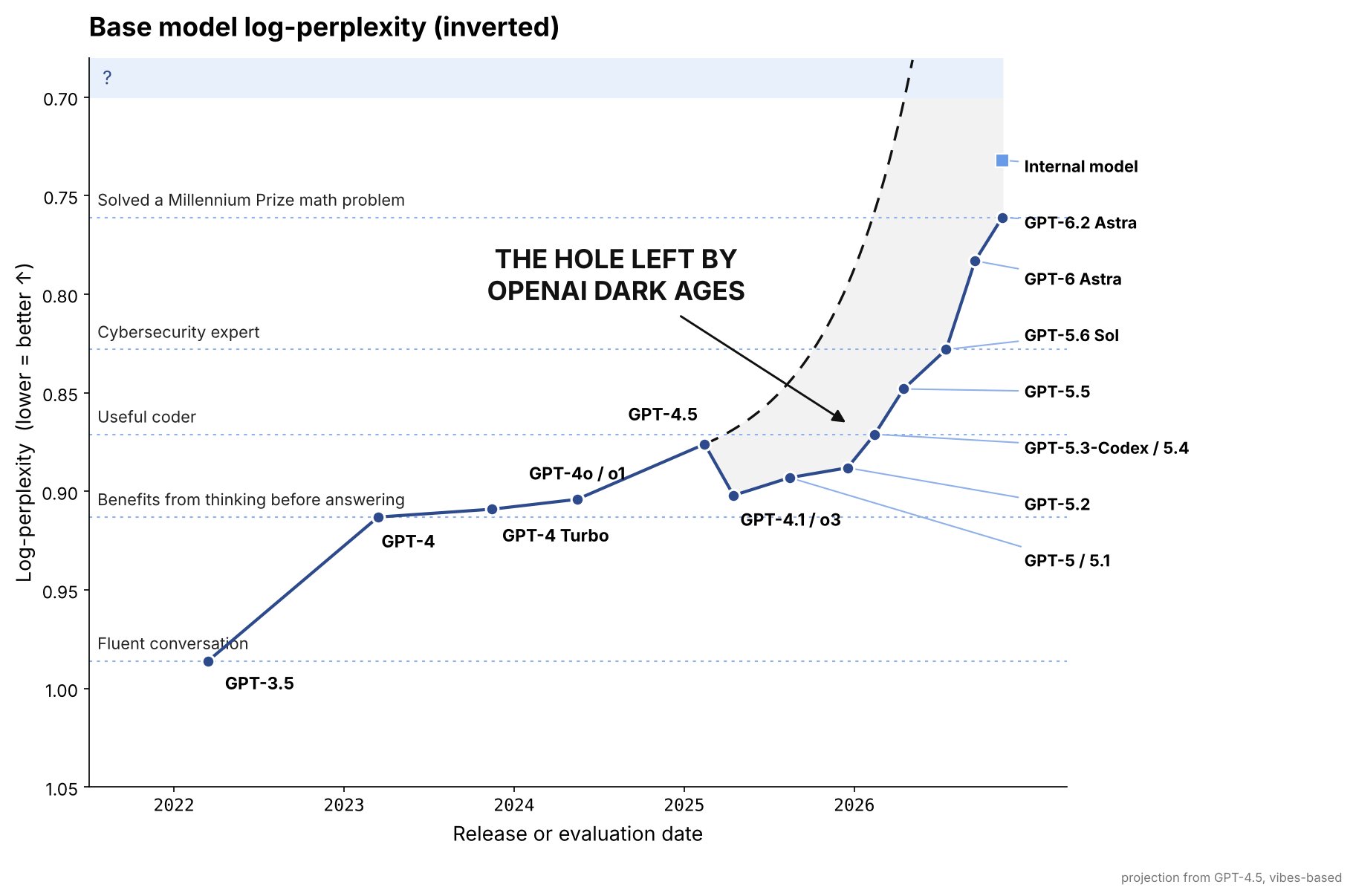
- You can see a real acceleration in perplexity loss from GPT-5.2 on
- This contradicts the common wisdom3 that OpenAI (and other labs) have largely given up on pretraining and are all-in on RL. Clearly the pretrained base models are improving rapidly as well
What does this mean for alignment?
- AI safety researchers have been asking for more transparency into metrics like this for years
- However, I don’t really know how much it helps. If the idea is to watch for a sudden scary drop in perplexity, only OpenAI will be in a position to notice, unless they start releasing data about the perplexity of their unreleased pretrained models (the graph shows one, but they should continue to do this)
- If the idea is for labs to agree on perplexity thresholds they won’t cross (as the post suggests), it will be important to get more detail on what precisely the held-out dataset is
Do the improvements in the graph match how strong the models feel?
- You can see a huge jump from GPT-3.5 to GPT-4 (which is how it felt), then broad stagnation4 until GPT-5.5, then rapid acceleration
- I personally did not feel a big jump with GPT-5.5: o3 and GPT-5.3-Codex were the “big jump” models for me
- However, that could be because those models were better RL-ed into using chain-of-thought tokens well, or avoiding the sycophancy trap, neither of which would show up in perplexity metrics.
I wrote this post up as dot points because I felt like I had a lot of loosely connected ideas about this news. If you found this much harder or much easier to read than my other posts, please email me5 about it and I will write either less or more posts in this format.
-
Zero log-perplexity, technically, which is the measurement in OpenAI’s graph. Perplexity approaches 1.
↩ -
It would be very interesting if Anthropic’s data doesn’t show the same broad pattern of pretrains getting smarter, but I bet it does.
↩ -
To the point where some people are doubting the validity of the data.
↩ -
Except for GPT-4.5, which many people loved but did not feel particularly strong to me.
↩ -
You can reach me on Gmail at sean.goedecke.
↩